As the core equipment of battery research and development, production and quality inspection, the battery charging and discharging aging cabinet provides comprehensive support for battery performance evaluation with accurate testing capabilities and stable operating performance. Its six core functions cover the full dimension of battery detection from basic performance to long-term reliability, becoming a key tool to ensure battery product quality.
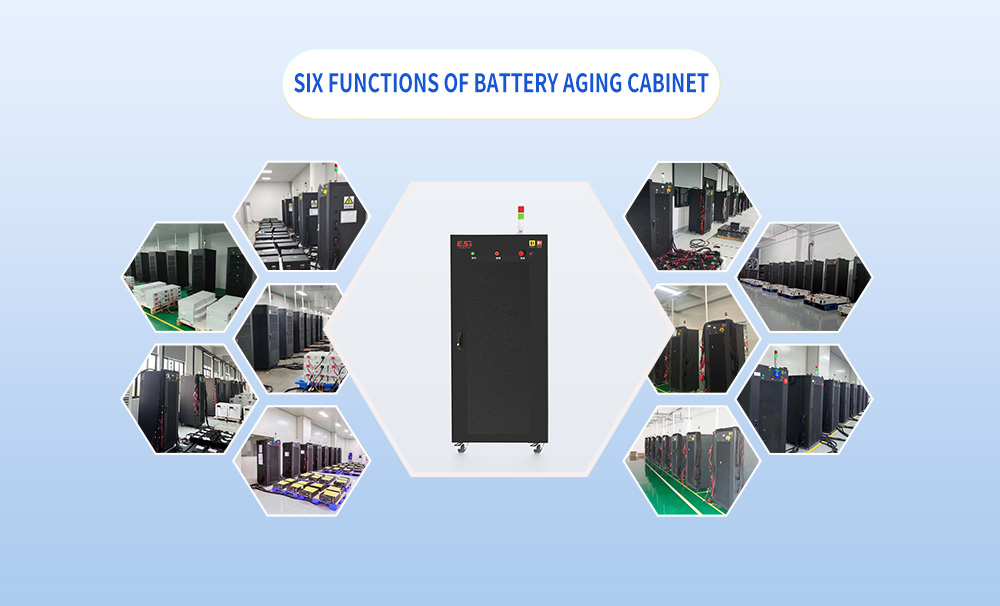
1. Basic charging and discharging test
Basic charge-discharge testing is a cornerstone function in battery performance evaluation, simulating the charging and discharging process of batteries in routine usage scenarios. The device controls the battery to complete a complete charging and discharging cycle by setting parameters such as constant current and voltage, and records the core data such as the battery's charging and discharging capacity, voltage change curve, and charging and discharging efficiency in real time. This function can not only quickly judge whether the battery meets the basic performance indicators, but also provide basic data reference for subsequent complex tests, which is a necessary link for battery factory inspection and batch quality screening.
2. DCIR internal resistance test
DCIR (Direct Current Internal Resistance) is a key parameter that reflects the internal conductivity of the battery, directly affecting the battery's charging and discharging efficiency and high-current output capabilities. The DCIR internal resistance test function of the battery charging and discharging aging cabinet accurately measures the internal resistance changes of the battery in different SOC (remaining power) states by applying an instantaneous DC load during the charging and discharging process. This test can timely detect potential problems such as poor contact of the internal poles of the battery and electrolyte aging, providing an important basis for battery consistency screening and life prediction, especially for power batteries, energy storage batteries and other products with strict internal resistance requirements.
3. Rate charge and discharge test
The rate charge and discharge test detects the performance of the battery under different current intensities, simulating the working state of the battery in extreme usage scenarios such as fast charging and rapid acceleration. The device can flexibly adjust the charge/discharge rate (such as 0.5C, 1C, 2C, or even higher) to record the battery's capacity retention, voltage stability, temperature rise, and other data at different magnifications. This function is of great significance for evaluating the fast charging capacity and high-current discharge reliability of batteries, and is the core test item for battery selection of new energy vehicles, portable electronic devices and other products.
4. Electrical performance test in high and low temperature environments
The battery performance is significantly affected by the ambient temperature, and the electrical performance test function simulates the extreme temperature environment of -40°C~85°C by integrating a temperature control system to detect the charging and discharging capacity, internal resistance, cycle stability and other indicators of the battery at different temperatures. For example, evaluating the starting ability of the battery in a low-temperature environment and verifying the safety performance of the battery in a high-temperature environment provides data support for the application of the battery under different climatic conditions, and is widely used in battery testing in outdoor equipment, new energy vehicles and other scenarios.
5. Capacity maintenance and recovery ability testing
The capacity holding ability test records the decay trend of battery capacity with the number of cycles through long-term cycle charging and discharging, and evaluates the performance stability of the battery after long-term use. The recovery ability test detects the recovery degree of battery capacity through the standard charging and discharging process after the battery has been deeply discharged or stored for a long time. The combination of these two functions can comprehensively reflect the durability and storage performance of the battery, providing key data for battery life assessment and usage scenario optimization, especially suitable for energy storage batteries, backup power supplies and other products with high capacity stability requirements.
6. Cycle life test
Cycle life testing is a core function to evaluate the long-term reliability of batteries, by simulating the actual use of the battery, conducting thousands or even tens of thousands of charge and discharging cycles, and recording the number of cycles when the battery capacity decays to 80% of the rated capacity (or a specified ratio). This test can accurately predict the service life of the battery and provide a scientific basis for product warranty period setting and battery design optimization. Whether it is a small battery for consumer electronics or a large battery pack such as power batteries and energy storage batteries, cycle life testing is a key link to verify the competitiveness of its products.
In summary, the six major functions of the battery charging and discharging aging cabinet from basic performance to extreme environments, from short-term performance to long-term reliability, have built a comprehensive battery performance testing system, which provides strong technical support for battery R&D innovation, production quality control, and application verification, and promotes the development of the battery industry in the direction of high quality and high reliability.