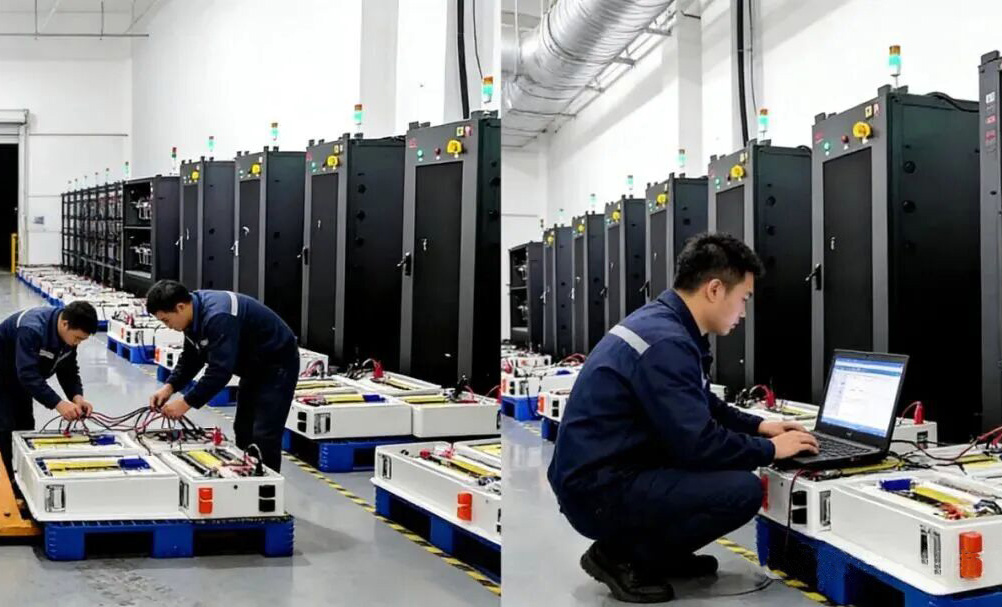
The working principle, maintenance methods and precautions of the battery aging cabinet
Infor
/
2025-12-09
1. Working principle
The battery aging cabinet is the core equipment of new energy battery production and testing, mainly used for theaging testof lithium batteries (such as power batteries, energy storage batteries, consumer lithium batteries), by simulating the actual use of batteries, screening out batteries with substandard performance to ensure the reliability of battery products, and its core working logic can be divided into 3 modules:
The core of the charging and discharging control module is the high-precision charging and discharging power supply and BMS (battery management system) simulation unit, which can charge and discharge a single battery or battery module according to preset programs (such as constant current and constant voltage charging, constant current discharge, pulse charging and discharging, etc.), accurately control current, voltage, power and other parameters, and simulate the working state of the battery in different scenarios.
Data Acquisition and Monitoring Module Built-in multi-channel sensors and data acquisition cards, real-time collection of core data such as battery voltage, current, temperature, capacity, internal resistance, etc., transmit to the main control system for analysis, and monitor the charging and discharging process of the battery.
Temperature Control and Safety Protection Module Equipped with an incubator or heat dissipation system to maintain a stable temperature in the test environment (usually at 25°C±5°C, some devices support a wide temperature range of -20°C~60°C) to avoid temperature fluctuations affecting the test accuracy. At the same time, it integrates over-voltage protection, over-current protection, short-circuit protection, over-temperature protection, explosion-proof devices, etc., to prevent thermal runaway, fire, explosion and other safety accidents during the aging process of the battery.
The overall process is: battery on-the-counter→ parameter setting→ charge and discharge cycle→ data collection and analysis→ determination of qualified/unqualified→ off-line sorting.
2. Common maintenance methods
The battery aging cabinet belongs to precision electrical equipment, and the maintenance needs to follow the principle of "power off first investigation, software first and then hardware, simple first and then complex", the following are common faults and corresponding maintenance plans:
1. Abnormal charging and discharging function
Fault phenomena: Unable to start charging and discharging, charge/discharge current/voltage deviation from the set value, charging and discharging interruption
Troubleshooting and maintenance:
First, check whether the main control program parameters are set incorrectly, and recalibrate the charge/discharge curve and threshold;
Check the output voltage and current of the charging and discharging power module, and replace the power module of the same model if the module is damaged;
Check whether the line connection is loose or poor contact, tighten the terminal strip, and replace the aging cable;
Calibrate the current/voltage sensor, recalibrate or replace it if the sensor drifts.
2. Data collection failure
Fault phenomena: no data display, data jumps, and excessive data errors
Troubleshooting and maintenance:
Check the communication link between the data acquisition card and the main computer (such as RS485, Ethernet), restart the communication module or replace the communication line;
If there is no data in a certain channel, check whether the channel interface is oxidized, clean the interface or replace the acquisition board;
Calibrate peripherals such as temperature sensors and internal resistance testers to ensure data acquisition accuracy.
3. Temperature control system failure
Fault phenomena: the temperature cannot reach the set value, the temperature fluctuates too much, and the thermostat alarms
Troubleshooting and maintenance:
Check whether the thermostat parameters are correct and reset the temperature control logic.
Clean the dust of the fan filter and condenser, and replace the fan motor if the fan does not rotate;
Inspect the heating/refrigeration compressor, if the compressor fails, contact a professional for repair or replacement;
Check the temperature probe for damage, replace the probe and recalibrate it.
4. The security protection is triggered by mistake
Fault phenomenon: Overvoltage/overcurrent/over-temperature protection is triggered when the threshold is not reached, and the equipment is frequently shut down
Troubleshooting and maintenance:
Recalibrate the protection threshold to ensure it matches the test conditions;
Check whether the protection sensor is short circuit or faulty, and replace the abnormal sensor;
Troubleshoot whether the battery has its own fault (such as internal short circuit) to avoid protection triggering due to battery problems, and replace the test battery for re-verification if necessary.
3. Precautions for operation and maintenance
1. Operational precautions
Personnel qualifications: Operators need to undergo professional training, be familiar with equipment operation procedures and battery safety knowledge, and hold a certificate.
Safety protection: Insulated gloves and goggles should be worn during operation, and flammable and explosive materials should not be stacked around the equipment.
Parameter setting: Set reasonable parameters according to battery specifications (such as nominal voltage, capacity, charge-discharge rate), and strictly prohibit over-specification testing to avoid damage to the battery and equipment.
Real-time monitoring: During the aging test, it is necessary to regularly inspect the status of the equipment and battery, check the data curve, and immediately stop the machine if abnormalities are found.
Battery loading and unloading: Handle and handle it gently when loading and unloading the cabinet to ensure that the positive and negative electrodes of the battery are wired correctly to prevent reverse connection and short circuit.
2. Routine maintenance precautions
Regular cleaning: clean the dust, heat dissipation channels and filters on the surface of the equipment every week, and clean the oxide layer of the collection interface every month to keep the equipment clean;
Regular calibration: calibrate the charging and discharging accuracy, data acquisition sensor, and temperature control system every 3~6 months to ensure accurate test data;
Line inspection: check the aging of cables, terminals, and connectors every month, replace damaged cables, and fasten loose terminals;
Spare parts reserve: reserve commonly used wearing parts (such as power modules, acquisition cards, sensors, fans) to avoid faults and downtime affecting production;
Maintenance records: Establish equipment maintenance ledgers to record failure times, causes, maintenance plans and replacement parts to facilitate traceability and preventive maintenance;
Regular inspections: Conduct comprehensive inspections of equipment every quarter, including electrical system insulation tests, safety device effectiveness tests, etc., to eliminate potential safety hazards.