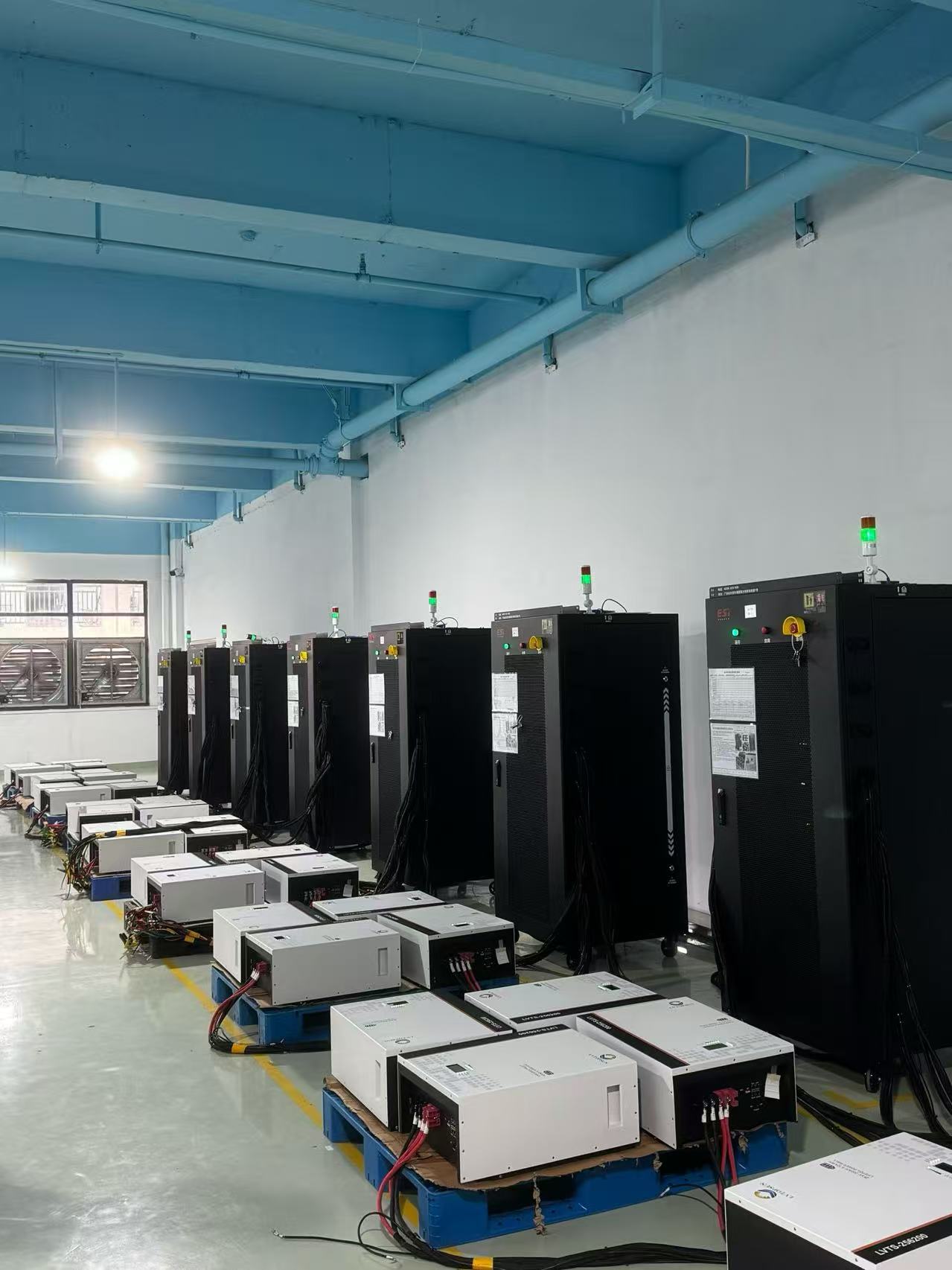
First, let's understand this device in one sentence:
this is an energy-saving charge-discharge cabinet used by factories/laboratories to perform cycle aging, capacity testing, and lifespan testing for lithium battery packs. It can simultaneously measure up to 24 battery groups, with a maximum current of 100V and a maximum current of 50A per group. The discharged electricity can be recovered back into the grid, saving electricity.
1. What does each digit in the model name represent?
- EST: Yishengda brand;
- BT: Energy Feedback Battery Tester (discharge energy recovery);
- 100V: Maximum single-channel voltage 100V (48V/60V/72V can be measured for two-wheel, three-wheel, and small energy storage batteries);
- 50A: Maximum single-channel charge/discharge current 50A;
- 24CH: A total of 24 independent channels, allowing 24 battery groups to be tested separately without interference.
-
2. What does this machine do?
Lithium batteries must be "simulated for several years" after leaving the factory and developed to age rapidly. Check whether the battery is durable and prone to failure:
- Automatically charges and discharges the battery, repeating thousands of times;
- Record how much power is charged and discharged each time, and assess capacity degradation;
- Record voltage, internal resistance, and temperature to identify defective products prone to bulging and large voltage differences;
- Energy Feedback: Ordinary aging cabinets discharge by heating resistors and consuming power; This unit converts battery discharge back into AC power and feeds it back to the factory grid, saving a lot on electricity costs
The entire equipment is divided into five main sections, which are easy to understand:
- Host computer: The software you operate, setting charging and discharging rules, viewing curves, and exporting data;
- Mid-position computer: intermediate transfer station for storing test data; records are not lost during sudden power outages;
- ACDC module: AC power from the power grid ↔ and internal DC power conversion between the machine (charging grid, discharging back to the grid);
- DCDC module: Each channel has independent charge/discharge control, directly connected to the battery;
- Lithium battery pack under test (with or without BMS protection board).
-
3. Core parameter translation
1. Voltage and current range (which batteries can be measured)
- Charging: 0~100V→ 48V (16 series), 60V, 72V electric vehicle batteries, and compact energy storage all compatible;
- Minimum discharge voltage 10V: does not forcibly push the battery to the scrap voltage;
- Current: 50mA~50A, supports both low-current slow charging and high-current fast charging;
- Single-channel maximum power 5KW: suitable for battery packs ranging from tens to 200 amph.
2. Accuracy (whether the measurement data is accurate)
Voltage/current accuracy ±0.05%, industrial high precision, with very small measurement and internal resistance errors.
3. Safety protection (prevents battery damage and machine burnout)
The machine comes with dozens of layers of protection, all automatically triggering shutdown:
overvoltage, undervoltage, overcurrent, overtemperature, wire breakage, reversed polarity, channel short circuit, program jamming, and automatic battery disconnection when suddenly power-off.
4. Testing Functions (What operations can the software perform)
All charging and discharging modes are automatically combined, no manual monitoring required:
constant current charging, constant voltage charging, constant current and constant voltage (lithium battery standard charging), constant power, pulse charge/discharge, internal resistance DCIR automatic calculation, unlimited cycles;
Cutoff conditions can be set arbitrarily: voltage stop-to-value, current to-stop, time-stop, capacity stop-stop, temperature over-limit stop;
Data is automatically recorded, generating voltage-to-capacity curves and exporting Excel spreadsheets for easy lifespan analysis.
4. Key point: Optional BMS communication module
1. Standard status: No BMS communication (default factory)
The machine only collects the total voltage and current of the battery, but does not know the voltage, temperature, or SOC of each internal cell string.
Disadvantages: Only the machine can set the total voltage protection itself; any overcharge or over-discharge inside the battery cannot be detected by the machine, posing safety risks.
2. Optional: Equipped with a 485/CAN communication module
The specifications specify optional support for RS485 Modbus, CAN bus, import DBC files, and connect the battery BMS protection board:
- The machine reads and uploads BMS in real time: voltage of each single unit, highest/lowest single, temperature difference, SOC, fault alarm;
- You can set the individual cell voltage as the shutdown condition: for example, if a certain batch is fully charged to 3.65V lithium iron, the device immediately stops charging, providing true closed-loop protection
- The difference between the two types of communication (combined with what was discussed earlier);
- CAN: High real-time performance, fault reporting in milliseconds, requires DBC protocol, suitable for automotive and high-power energy storage BMS;
- RS485 Modbus: Low cost, commonly used in simple protection boards like two-wheeler JK and Dali, polling and reading data, slower response;
- New features after selection: the software allows viewing each string of cell data, cycle records to save individual cell pressure differences, and filtering for cells with poor consistency.
-
3. Optional two additional auxiliary modules
- PT10 Temperature Channel: Measures battery surface temperature, automatically shuts down at high temperatures;
- Voltage auxiliary channel: Collects the voltage of each cell in each string separately (used when no BMS is available).
-
5. Two wiring methods (split port / same terminal)
- Same port (standard alligator clip): charging and discharging share two thick wires (red positive, black negative), suitable for low-power two-wheel batteries;
- Ports (optional OT terminal): One charging cable and one discharge wire are separate; dedicated to high-current, high-power batteries, resulting in lower heat generation.
-
6. What is energy feedback? Beginners care most about saving money
Ordinary aging cabinet: All battery discharge becomes wasted heat, air conditioners need to dissipate heat, and electricity costs are sky-high.
Discharge process of this equipment:
DC battery → machine converts to AC power → sent back to the factory grid for use by other equipment;
The entire machine recovers up to 90% of its energy, and long-term extensive battery testing can save more than half of electricity costs.
7. What can software do?
- Visual interface: 24 channels simultaneously display each group of real-time voltage, current, capacity, and temperature;
- Customizable workflow steps: for example, → constant current charging after 1 hour of standing→ constant current discharge → standing idle, with automatic cycles of tens of thousands of times;
- Curve plotting: freely combine time, voltage, and capacity curves to visually observe how much battery capacity decreases over cycles;
- Data is automatically stored in the MySQL database, exported to Excel anytime for lifetime reports;
- Permission management: Administrators and operators are separated to prevent unauthorized modification of testing processes.
-
8. Safety-related key areas
- Power must be three-phase 380V industrial electricity; household 220V cannot be used;
- Wires must not be reversed; the machine has anti-reverse protection, but frequent reverse connections can burn out the clips;
- Do not unplug the power cable during testing, as it can easily cause sparking and short circuits;
- If the battery suddenly goes off, it automatically disconnects the battery. When power is restored, you can repeat the previous cycle and continue testing without starting over;
- Supports channel parallel: 2 channels combined for up to 500A high current, testing high-power energy storage batteries.
-
9. Summarize the entire logic in one sentence
- This unit is a 24-channel 100V 50A energy-saving battery aging cabinet that automatically cycles to measure battery life and capacity;
- By default, it can only measure total battery voltage; after selecting the 485/CAN communication module, it can communicate with the BMS protection board;
- CAN parses battery messages via DBC, while RS485 reads individual data via Modbus registers. After reading the voltage and temperature of a single string, the device automatically protects to prevent overcharge and over-discharge from damaging the cells;
- Discharging energy is recovered from the grid, significantly saving electricity compared to ordinary resistive aging cabinets, suitable for PACK factories, energy storage, and electric vehicle battery R&D and aging testing.