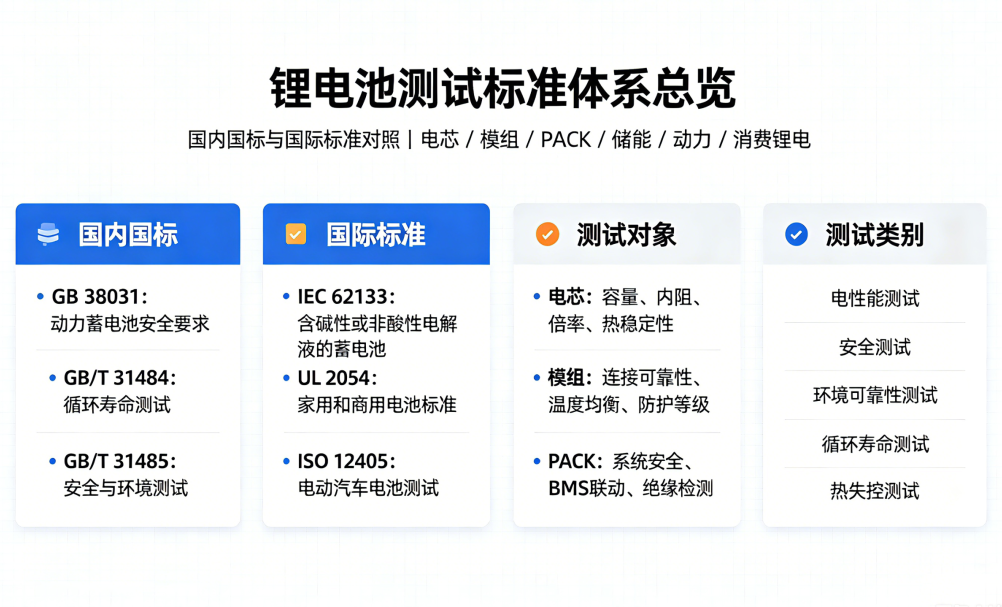
-
GB 31241-2022 "Safety Technical Specification for Lithium-ion Batteries and Battery Packs for Portable Electronic Products" [Mandatory National Standard | 3C Certification Basis]
Applicable to: mobile phones, laptops, power banks, Bluetooth earphones, power tools, handheld barcode scanning devices, small portable digital cells & battery packs
Battery cell safety testing projects
- External short circuit at room temperature
SOC: fully charged; External resistance≤ 0.05Ω; continuously observed for 1 hour; Determination: Non-fire, non-explosive, non-liquid leakage
- High-temperature external short circuit
After standing in a 55°C constant temperature chamber for 4 hours, a short circuit occurs; other conditions are the same as above
- Overcharging
Charging at 3 times the standard charging current; Three-way system charging up to 4.6V; Lasts up to 7 hours; No explosion or fire
- Forced discharge (reverse charging)
External power supply reverse forced discharge; Simulates the risk of the battery cell being charged in the reverse direction
- Low pressure (simulates air transport low pressure)
11.6kPa,6h; Simulates high-altitude transport, with no cracks or leakage
- Temperature cycling
-40°C~85°C, high and low temperatures for 4 hours each, 10 cycles
- Vibration test
7Hz~200Hz sine sweep, three-axis vibration
- Acceleration impact
Peak 150g, 6ms semi-sine wave, impact in six directions
- Free fall
1.2m high, hard cement surface, six faces fall in sequence
- Squeeze test
Steel flat extrusion with pressure until the shell deforms or reaches the load corresponding to the cell's weight; No fire or explosion allowed.
- Heavy objects impact
A 9.1kg steel rod from a height of 61cm is struck vertically against the large surface of the cell
- Thermal abuse (oven baking)
Heat at 5°C/min to 130°C and hold for 30 minutes
Additional testing of battery packs (PACK + BMS).
Overvoltage charging protection, overcurrent charging protection, undervoltage discharge protection, overload protection, short-circuit protection, reverse charging, flame retardant testing, washing testing; Verify the reliable operation of BMS protection logic.
Key changes in the old and new versions: GB31241-2022 added requirements for thermal runaway propagation and strengthened pouch lithium polymer testing requirements, which are mandatory 3C testing standards for mobile power banks.
2. GB 38031-2025 "Safety Requirements for Power Batteries Used in Electric Vehicles" [Mandatory National Standard | New Car Announcement Access, Replaces 2020 Edition, Effective 2026-07-01]
Applicable to: power cells, modules, battery packs, and battery systems for new energy passenger vehicles / commercial vehicles.
(1) Cell Cell Testing Items
-
-
-
External short circuit test
-
-
Acupuncture test (core mandatory item: no fire or explosion after needling).
-
-
- External short circuit after fast charging cycle (added in 2025 version)
Process: 20% to ↔80% fast charging cycles 300 times → Stand-to-the-loop → External short circuit; Verify the safety baseline after long-term fast charging ages.
(2) Battery Pack/System PACK-Level Testing (16 items in total)
-
Vibration test (random vibration + fixed frequency vibration, simulating full vehicle road bumps, fixed according to the vehicle's installation method)
-
- Bottom Impact (Major New Addition)
Simulating vehicle support and hard objects hitting the battery underside on the road
✅ Determination: No electrolyte leakage, no casing cracks, no fire or explosion; After testing, the insulation resistance ≥ 100Ω/V
-
-
Soak in seawater (soak in 3.5% NaCl solution for 2 hours)
-
-
Humidity-heat circulation
-
-
Insulation performance testing
-
-
-
- Thermal diffusion test (core vehicle safety)
Triggering thermal runaway for one of the cells; The new standard requires that the battery system must not catch fire or explode, and a warning signal must be sent to the entire vehicle in advance; high-temperature flue gas must not enter the passenger cabin.
-
-
-
BMS Function Verification (Equalization, High-Voltage Interlock, Contactor Protection)
3. GB 44240-2024 "Safety Requirements for Lithium-ion Batteries and Battery Packs Used in Electrochemical Energy Storage Power Stations" [Mandatory National Standard | Effective August 1, 2025]
Applications: residential energy storage, commercial and industrial energy storage, grid-side energy storage, base station backup power cells, modules, battery clusters. Core focus: suppression of thermal runaway spread, long-term static safety, and cluster-level interlock protection.
Main test items: Cells: overcharge, over-discharge, external short circuit, extrusion, thermal abuse, needle punch; Module/PACK: temperature cycling, vibration, shock, water immersion, damp heat, module thermal diffusion tests, cluster-level thermal spread assessment; Differences from power batteries: energy storage batteries focus on long-term float charging, calendar aging, and risks of uneven multi-series and parallel connections; Needle punch requirements can be waived according to the system's protection plan.
4. Recommended standards for power battery supporting performance (measuring capacity, cycle, power, not mandatory safety)
-
GB/T 31486-2024 "Electrical Performance Requirements and Test Methods for Power Batteries Used in Electric Vehicles"
Test contents: appearance, dimensions and weight, room temperature capacity, charge and discharge rate 0.2C/0.5C/1C/2C, -20°C low-temperature discharge, 55°C high-temperature discharge, charge retention capability (self-discharge), capacity recovery, DC internal resistance, energy efficiency, constant power discharge.
Standard test procedure example (room temperature rated capacity): 25°C constant temperature standing→ standard charging → standing for 1h→1C constant current discharge to cutoff voltage; Repeat 5 times to obtain a stable volume.
-
GB/T 31484-2015 "Cycle Life Requirements and Test Methods for Power Batteries Used in Electric Vehicles"
Two major tests: (1) Standard cycle life: charge and discharge cycles at room temperature and fixed SOC windows; Industry universal threshold: 1000 cycles ≥80% initial capacity; (2) Cycle life: simulates vehicle dynamic power load (NEDC/CLTC operating power curve), closer to real vehicle use.
-
GB/T 31467-2023 "Test Methods for Electrical Performance of Lithium-ion Power Battery Packs and Systems for Electric Vehicles"
PACK completes the machine's leveled energy, peak power, charge/discharge efficiency, high and low temperature energy output, and operating condition simulation.
2. International Standard (Detailed Parameters)
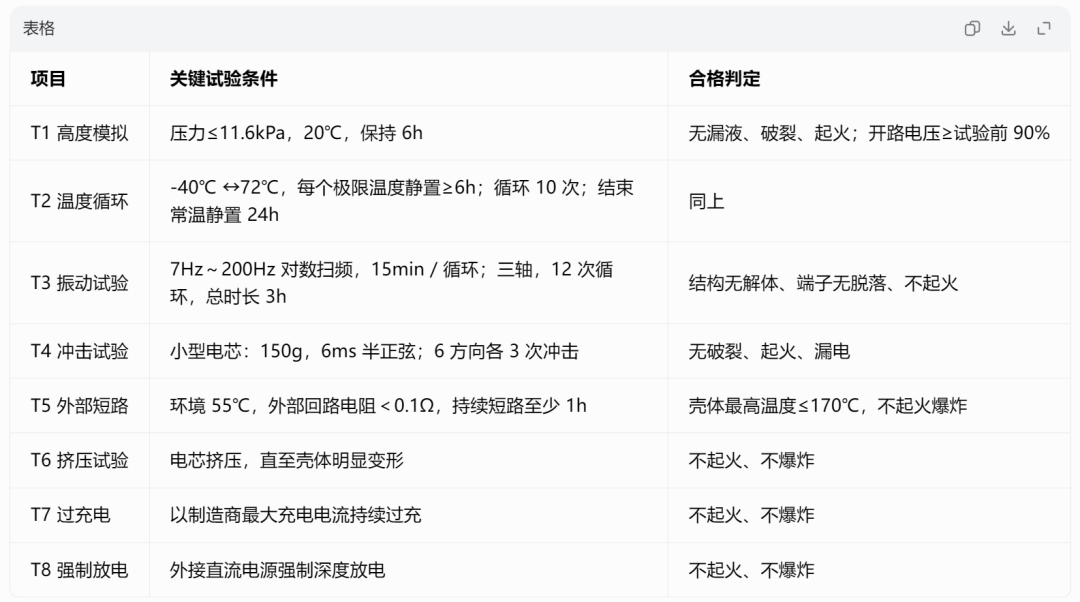
1. UN 38.3 "UN Dangerous Goods Transport Testing and Standards Manual Chapter 38.3" [Global Air/Sea/Land Transport Mandatory Transport Test].
⚠️ Important reminder: Only transport safety testing is used and cannot replace IEC/UL/GB for market sales certification. Cross-border shipping logistics must provide a UN38.3 report. A total of eight complete tests for T1~T8, with samples uniformly adjusted to fully charged SOC