
Are the dozen or so protective features of aging cabinets dazzling to look at? Breaking down the dual-layer software and hardware system—a thorough explanation!
Infor
/
2026-09-14

Opening the specifications of the Yishengda aging cabinet, aren't you overwhelmed by the densely packed dozen or so protective features? Overcurrent protection, voltage clamping, trend protection, program jamming protection...... You can't tell what is hardware-level safety net and which is software-level control, nor what each function is trying to protect against or what value it has for actual factory production. Don't worry, this article will explain everything thoroughly to you all at once.
60273958_1789377409.jpg

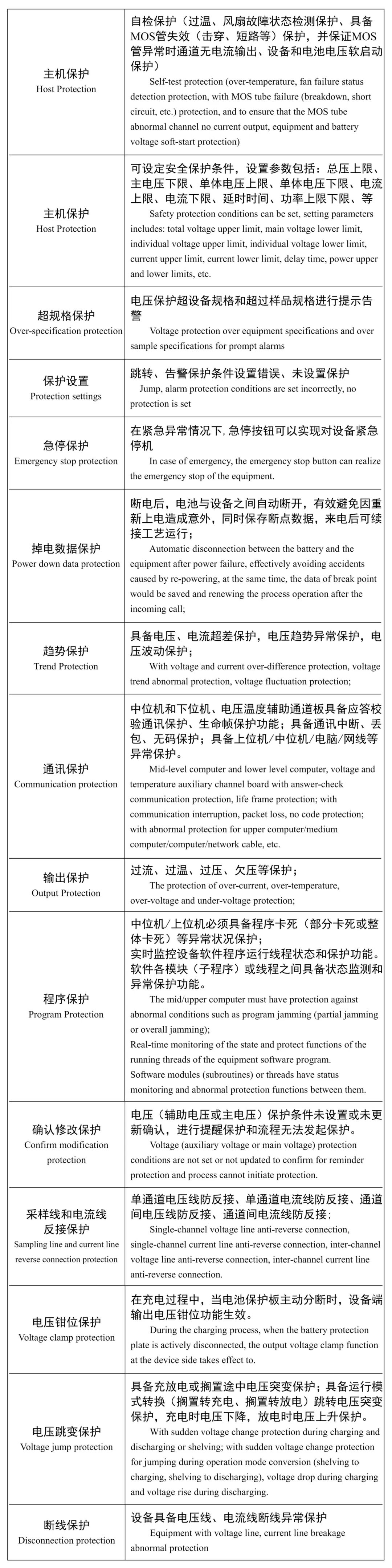
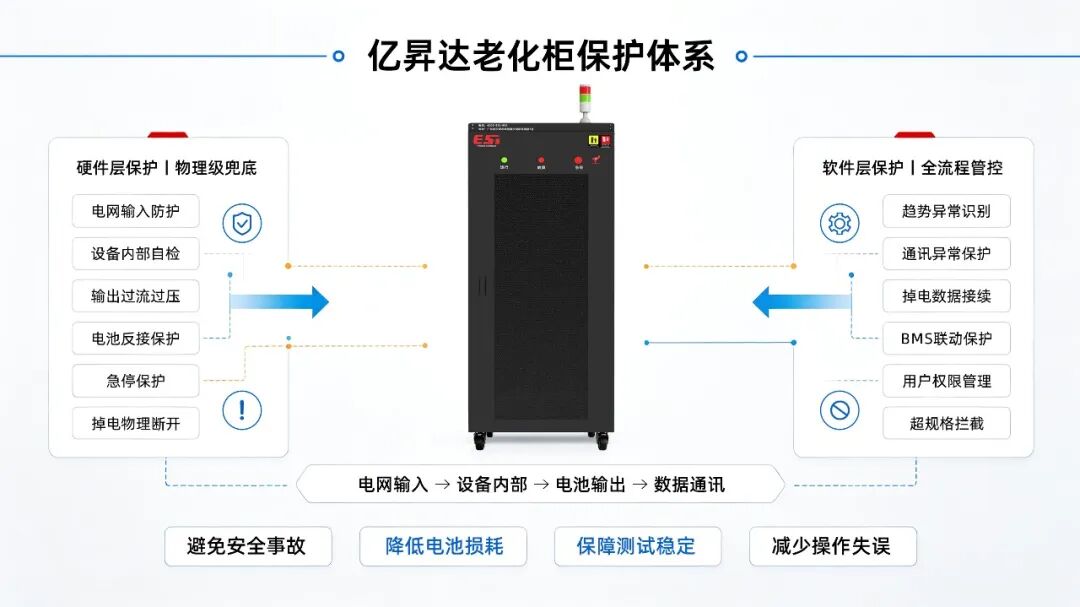
The protection system can be clearly divided into hardware layer protection and software layer protection, covering the entire chain from grid input, device interior, battery output to data communication. All functions are designed around four core values: "avoiding safety incidents, reducing battery wear, ensuring stable testing, and minimizing operational errors."
30498567_1789377437.jpg


1. Hardware layer protection (physical-grade bottom-line protection, millisecond-level response)

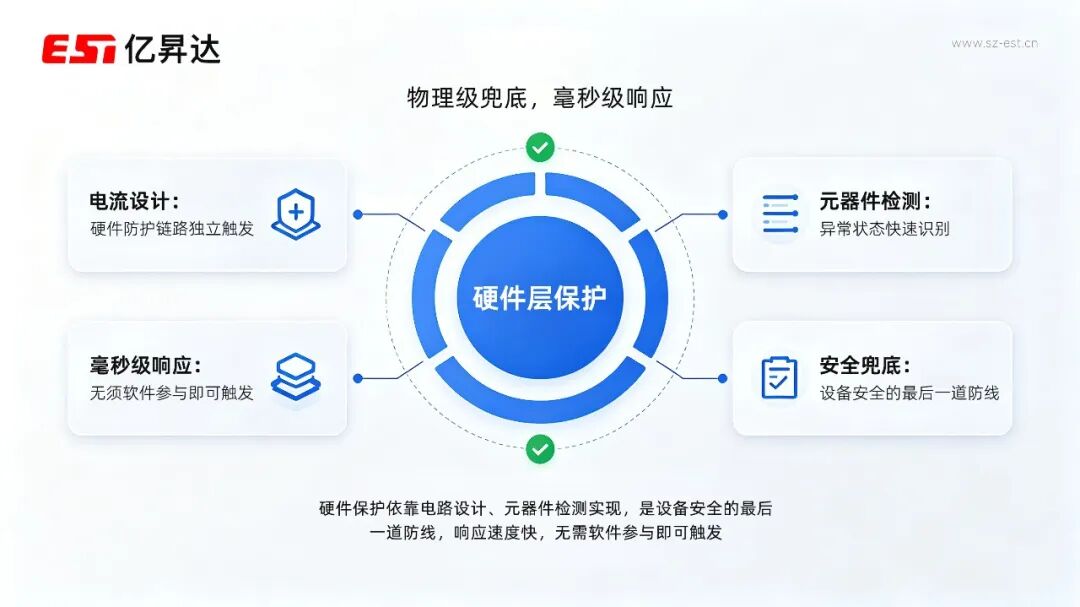
Hardware protection relies on circuit design and component inspection, serving as the last line of defense for equipment safety, with fast response times and triggers without software intervention.
45187926_1789377466.jpg


1. Grid input side protection

  • AC Input Comprehensive Protection (surge protection, islanding protection, over/under-frequency, over/undervoltage, phase loss protection, leakage protection, over-temperature protection)
    Meaning: Targets 380V Hardware protection circuits designed for various abnormal operating conditions in three-phase input power grids.
    Function: Resists risks such as lightning surges, grid voltage fluctuations, phase loss, and leakage, prevents damage to the equipment's ACDC power module, and ensures on-site electrical safety, preventing electric shock accidents.


2. Internal protection of the equipment main unit

  • Self-check protection (over-temperature detection, fan fault detection, MOSFET failure protection, soft start protection)
    means that during equipment startup and operation, Hardware circuits automatically detect the status of core power components.
    Function: When equipment overheats, fans stop, or power transistors break down and short circuit, immediately cut off channel output; The soft start mechanism suppresses power-on impulse current, extends component lifespan, and reduces equipment failure rates.
 

3. Battery and output side protection

  • Output basic protection (overcurrent, overtemperature, overvoltage, undervoltage protection)
Meaning: When the output voltage, current, or temperature exceeds hardware thresholds, the circuit immediately cuts off the output.
Function: Prevents large currents caused by battery overcharging, over-discharging, and short circuits, avoiding damage to battery modules and device power modules, and is the most basic safety protection.

  • Meaning of dynamic load protection
    : real-time detection of sudden load changes, providing buffering protection against current surges caused by loose connectors or poor contact.
    Function: Prevents battery sparks and false current shocks from damaging the battery BMS board and module electronic components, reducing connector losses.


  • Meaning of voltage clamping protection
    : If the battery protection board automatically disconnects during charging, The output voltage at the device end is automatically clamped within the safe range.
    Function: Prevents device no-load voltage spikes after battery disload, avoiding breakdown of protection boards or device interface circuits.


  • Meaning of voltage jump protection
    : During charge/discharge switching or hold-to-charge/discharge, hardware suppresses the slope of voltage abrupt changes.
    Function: Prevents voltage surges and drops from impacting the cell's chemical system, protects the internal structure of the battery, and extends battery cycle life.
 
  • Meaning of Broken Line Protection
    : Detects abnormal disconnection of voltage sampling lines and power current lines.
    Function: Immediately shuts down the device when the circuit is disconnected, preventing the risk of battery overcharge or over-discharge caused by open-circuit loss or detection distortion.
 
  • Sampling line/current line reverse connection protection
    Meaning: Hardware protection when voltage and current lines inside or between single channels are reversed when positive and negative.
    Function: Prevents battery short circuits and equipment burnout caused by wiring errors, avoiding safety hazards caused by manual wiring operations.
     
  • Emergency stop protection
    Meaning: Physical emergency stop button on the machine body; triggering it causes the entire machine to cut off power and shut down.
    Function: Quickly cuts off output in case of sudden abnormalities, ensuring the safety of on-site personnel, equipment, and the tested battery.
     
  • Physical disconnection protection during power failure
    Meaning: After an external power grid is cut off, the battery and device are automatically and physically disconnected.
    Function: Prevents the inrush current generated during re-energizing to accidentally damage the battery, and prevents the battery from being powered back and damaging the device.


2. Software Layer Protection (Logistic-Level Control, Full Process Coverage)

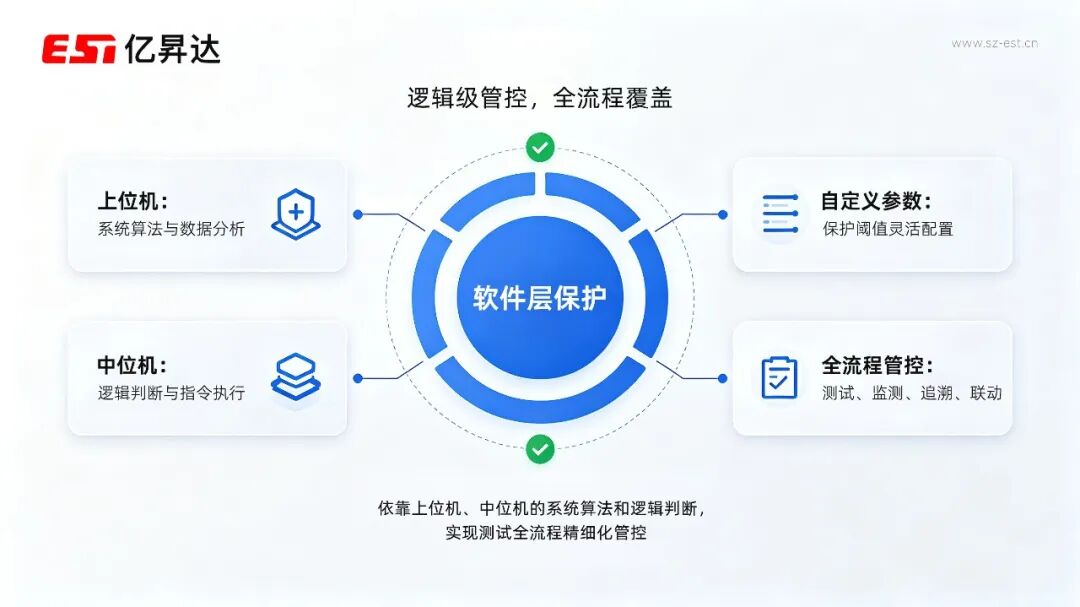
Software protection relies on system algorithms and logic judgments of the host and mid computers, allowing for customizable parameters and providing refined control throughout the entire testing process.
54619238_1789377503.jpg


1. System and program protection

  • Program freeze protection
    Meaning: Real-time monitoring of the software thread status of the host and mid computers, automatically triggering security mechanisms when local or overall freezes.
    Function: Prevents software downtime that could lead to uncontrolled testing processes and battery overcharge and over-discharge, ensuring stable operation during long-term aging tests.
     
  • Confirm modification protection
    Meaning: If protection parameters such as voltage and current are not set or updated for confirmation, the test process cannot start and a notification will pop up.
    Function: Prevents operators from missing protection parameters, avoids unprotected equipment operation, and avoids operational errors at the source.

2. Test operating condition protection

  • Exceptional protection
    Meaning: When the set test parameters exceed the device's rated specifications or the battery's nominal specifications, it automatically issues an alarm and intercepts startup.
    Function: Prevents incorrect setting of over-range parameters, protects equipment and the tested battery, and prevents mass scrapping caused by human error.
     
  • Trend protection
    Meaning: Does not rely on fixed thresholds, monitors voltage and current trends and fluctuations in real time, and identifies abnormal warning signs.
    Function: More advanced than threshold protection, predicting abnormalities before faults occur, intervening earlier to minimize battery damage.
     
  • Custom cutoff / jump protection
    Meaning: Allows setting multi-dimensional cutoff conditions such as voltage, current, time, capacity, and temperature. When thresholds are reached, the worker automatically switches to the worker step or stops testing.
    Function: Precisely matches the testing process requirements of different batteries, flexibly controls charge/discharge depth, and prevents overcharging and over-discharging.

3. Data and communication protection

  • Power outage data continuity protection
    Meaning: In the event of a sudden power outage, breakpoint data and process progress are automatically saved. After power is restored, the original process can continue operation.
    Function: Prevents power outages that could cause entire battery tests to be voided or data lost, reduces rework costs, and ensures data integrity.
     
  • Communication protection
    Meaning: Equipped with mechanisms for communication interruption, packet loss, no-code detection, and lifeframe verification, covering the entire link including host computer, intermediate computer, and network cable.
    Function: Automatically triggers a safe shutdown in case of communication abnormalities, preventing communication interruptions that could cause equipment loss of control, ensuring reliable test data transmission.
     
  • BMS Linkage Protection (Optional)
    Meaning: Connects to the battery BMS system via CAN/485 communication, collects real-time data on individual cell voltage, temperature, SOC, etc., and automatically stops testing in case of abnormalities.
    Function: Linkage protection at the battery body level, accurately identifying cell-level abnormalities, early warning of thermal runaway risks, and adapting to high-end module testing needs.

4. Operation permission protection

  • User hierarchical management
    Meaning: Supports permission management, role management, multi-user ID settings, with different accounts corresponding to different operational permissions.
    Function: Prevents unauthorized personnel from arbitrarily modifying process parameters and protection thresholds, ensures controllable production testing standards, and reduces the risk of human error.


3. Core Value Summary


This integrated full-link protection system for factories is reflected in three main aspects:


      1. Safety Guarantee: Covers multiple layers of protection from the power grid to the cells, significantly reducing the risk of major safety incidents such as battery fires and equipment burnout;

      2. Cost reduction and loss reduction: Minimize battery scraps and equipment damage caused by operational errors and abnormal working conditions, thereby lowering production losses.

      3. Stable and reliable: Supports long-term continuous aging testing, data traceability, and controllable operating conditions, enhancing consistency in production line quality control.
      1.  

      Hotline

      +86-18566565000

      Follow Us