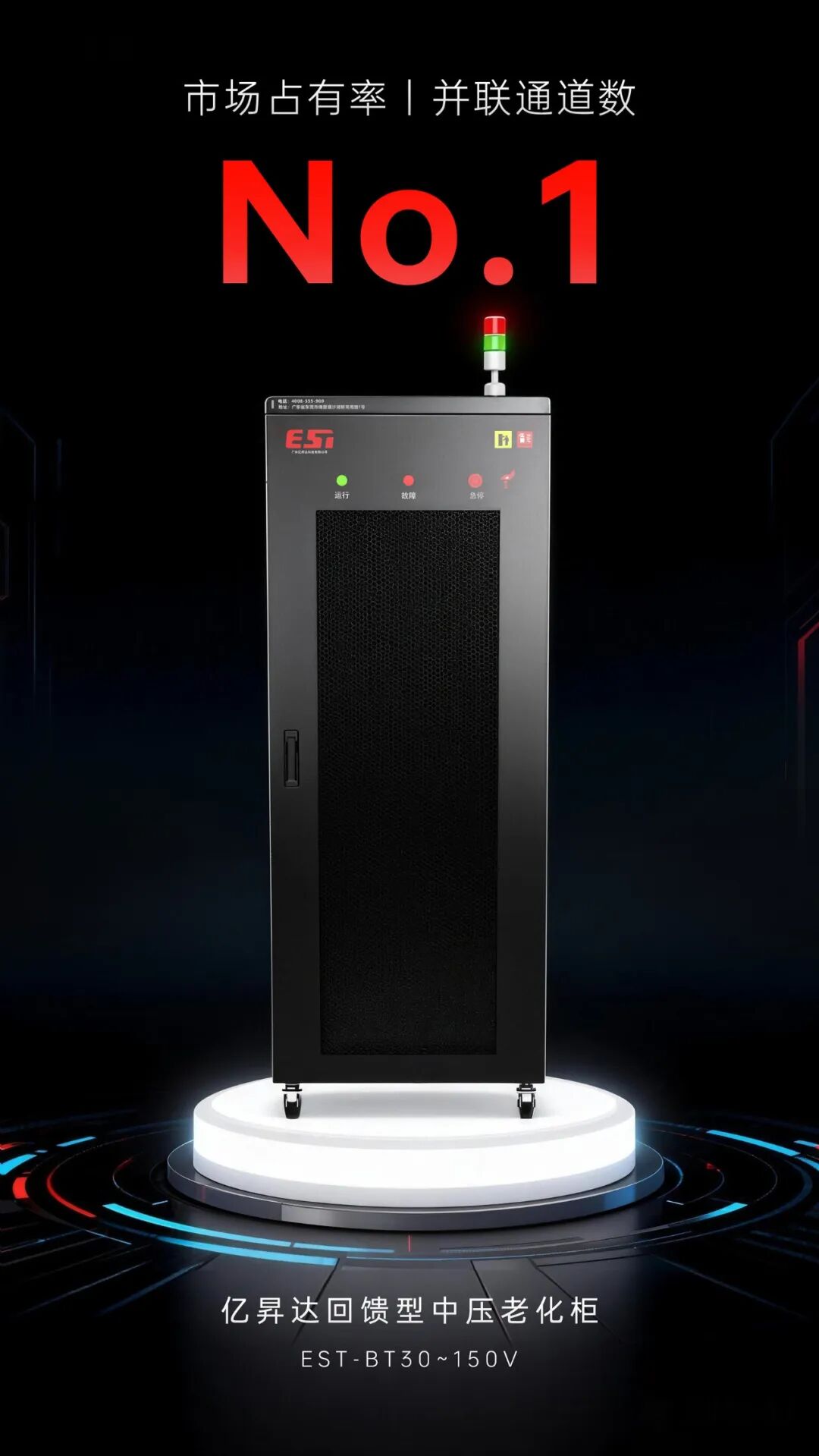

This article focuses solely on battery modules, PACK complete packs, energy storage battery packs, two-wheeler/electric motorcycle/passenger car power battery pack aging cabinets, excluding battery cell testing-related content. It breaks down the complete selection logic around three core dimensions: number of channels, single-channel power, and inspection accuracy, supporting practical calculations, scenario cases, pitfall avoidance points, and adapting to PACK production line aging, laboratory reliability cycles, Full-scenario full-scenario energy storage package validation.
1. Basic Definition and Core Features of PACK/Module Aging Cabinets
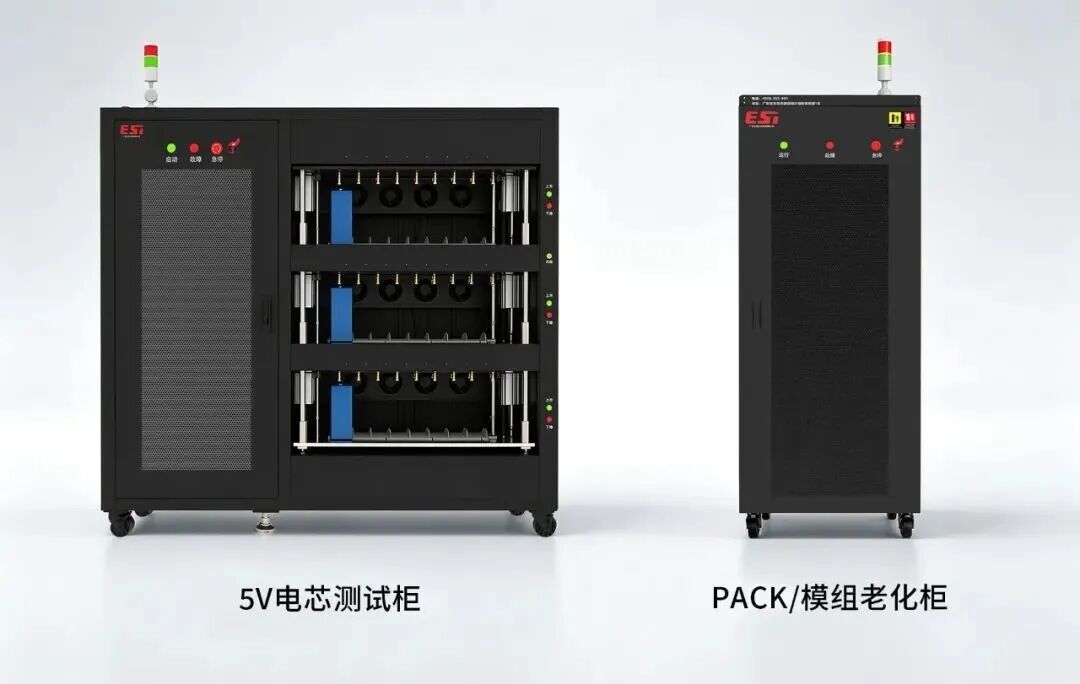
Unlike 5V cell test cabinets, the core features of PACK/module aging cabinets are:
Wide voltage range:
Full coverage of 12V~1000V, compatible with multiple strings of lithium battery modules, high-voltage vehicle packs, and energy storage clusters;
High power on single channel:
Single-channel charge/discharge currents from tens to hundreds of amperes, meeting 0.2C~1C and even fast charging rate cycles;
Supporting BMS Interaction:
Standard CAN/RS485 communication enables synchronous collection of battery pack differential pressure control, temperature control, and protection board fault signals;
Maximum safety features:
Multiple hardware and software protections are standard;
Mainstream architecture:
Mainly energy-feedback type, with very few resistive loads, suitable for long-term batch cyclic aging.
PACK/module batteries are large in size and require long single-charge and discharge cycles. The design logic for channel count is completely different from that of cell cabinets, with core elements based on daily capacity, cycle duration, and battery specifications.
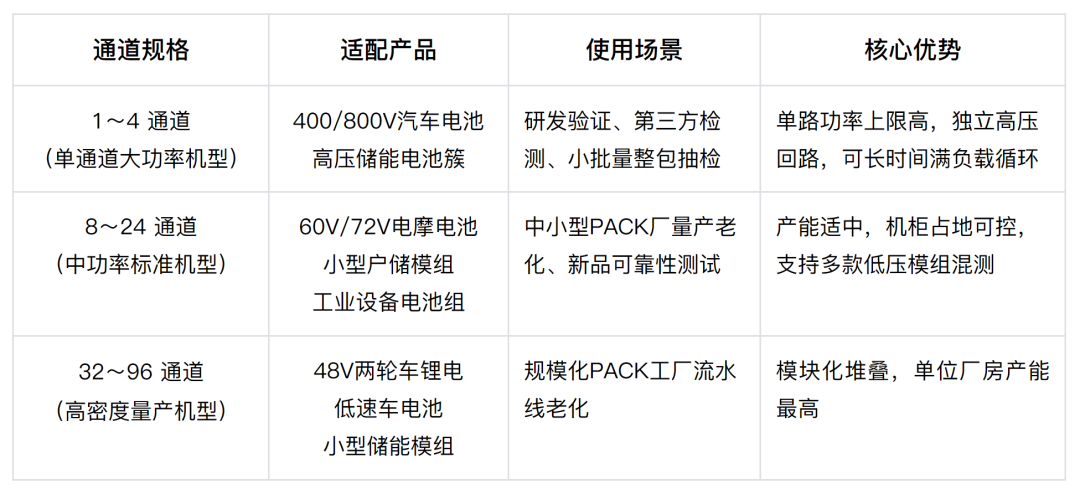
Channel levels correspond to applicable scenarios
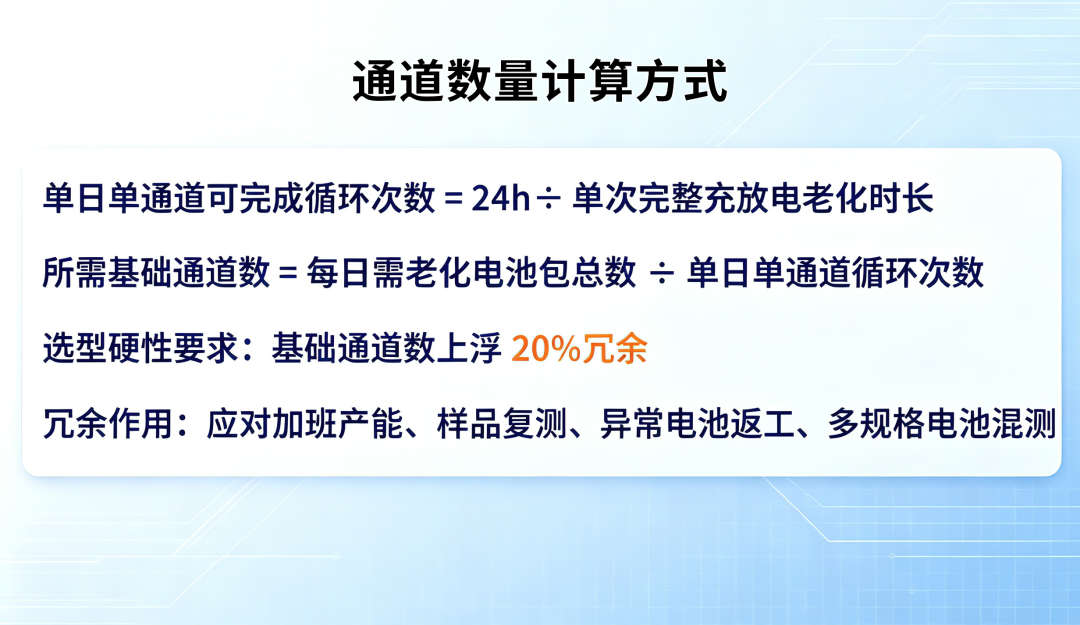
2. Channel Number Calculation Formula (Practical Application)
The channel must be a completely independent power circuit
Multi-channel power source sharing is prohibited. PACK battery voltage difference and BMS signal sensitivity; shared modules cause crosstalk during charging and discharging, resulting in distorted voltage, capacity, and internal resistance data, making it impossible to determine factory quality.
High-voltage PACK prohibits mixing multi-channel parallel use
For high-voltage models above 400V, the number of channels per cabinet should be controlled within 4 channels to avoid insulation and short-circuit safety hazards caused by parallel high-voltage circuits; For high current demand, simply choose the single-channel expansion model.
Automated production lines prioritize splitting multiple containers of the same specification
With over 500 sets of 48V battery packs per day, it is not recommended to use a single 128-channel oversized cabinet; splitting it into 3 units of 40 channels allows the other unit to operate normally in case of equipment failure, reducing the risk of production line shutdowns.
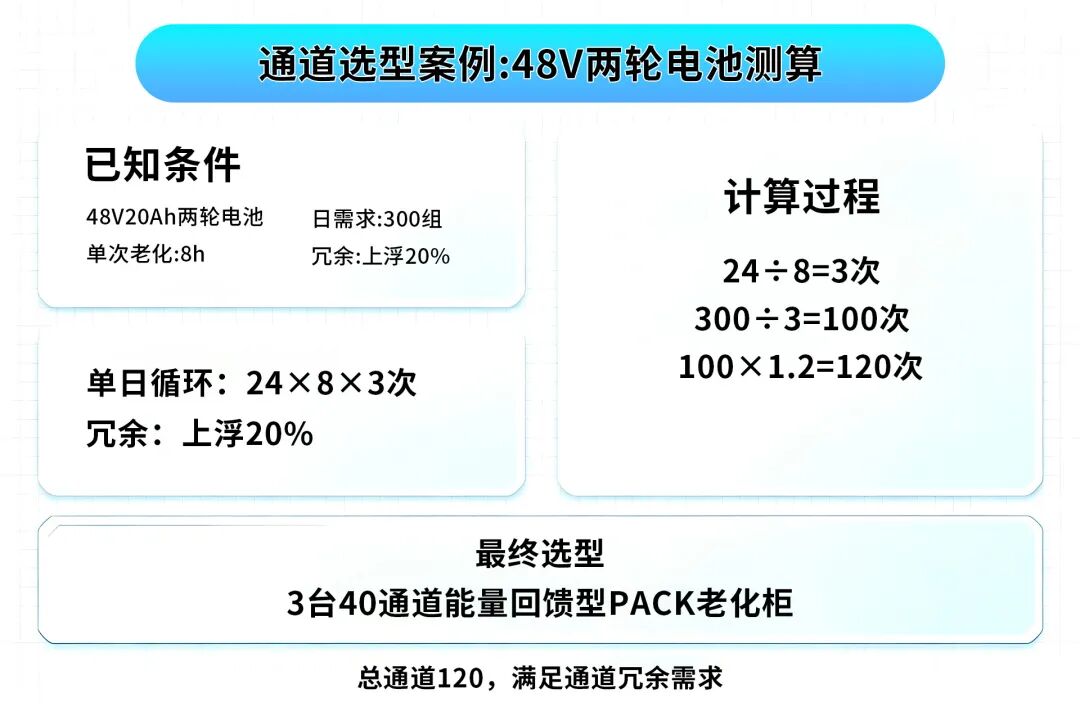
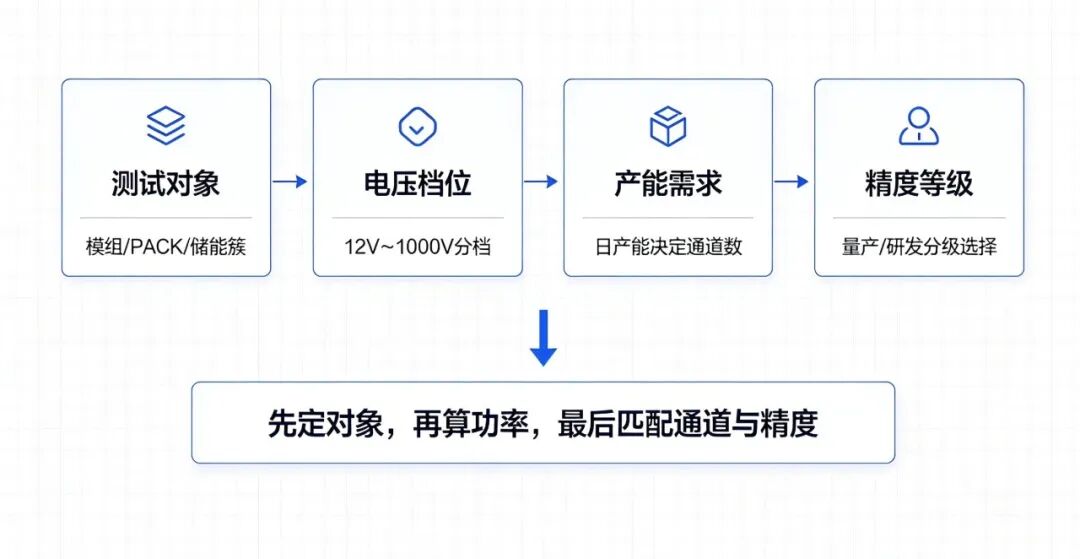
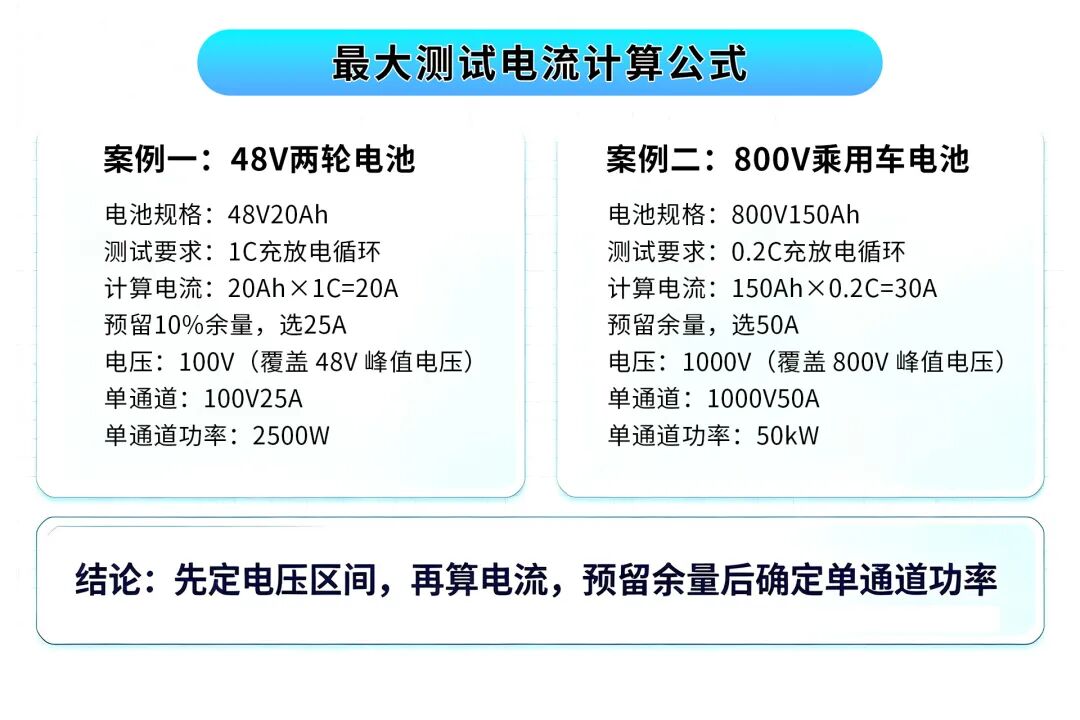
Single-channel rated power = Maximum test voltage (V) × Maximum charge/discharge current (A). Selection sequence: first determine the voltage range, then calculate the current based on the battery rate, and finally determine the total power specification.
12V\75V low to medium voltage range: 3S\16S modules, 48V two-wheelers, power tools, drone battery packs;
100V~150V medium voltage range: 60V/72V electric motorcycles, small commercial and industrial energy storage modules;
400V~1000V high-voltage range: New energy vehicle PACKs, large energy storage battery clusters, commercial and industrial energy storage cabinets.
Maximum charge/discharge current = Battery rated capacity (Ah) × Test cycle rate
Key Points for Selection: The maximum test current calculated > the device's rated current, with a 10% current margin reserved to handle fast charging and pulse aging tests.
Symmetrical charge and discharge currents are prioritized
For mass production aging and lifecycle cycles, models with symmetrical charge-discharge currents must be selected. Asymmetric devices have insufficient charging power and cannot charge at full rate, so battery aging data is not reliable.
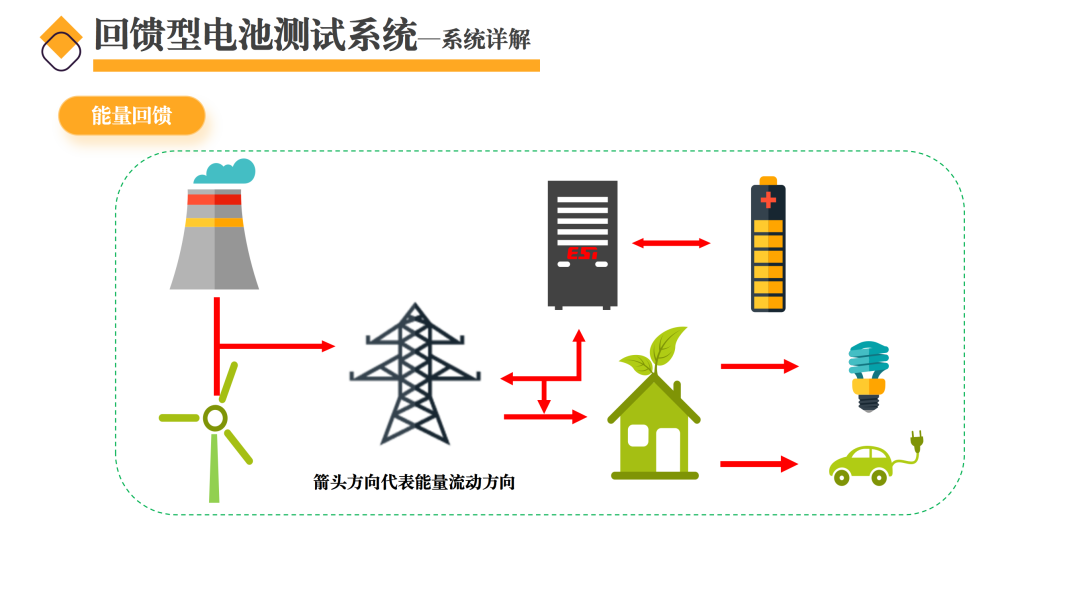
The energy feedback type is the standard in the PACK industry
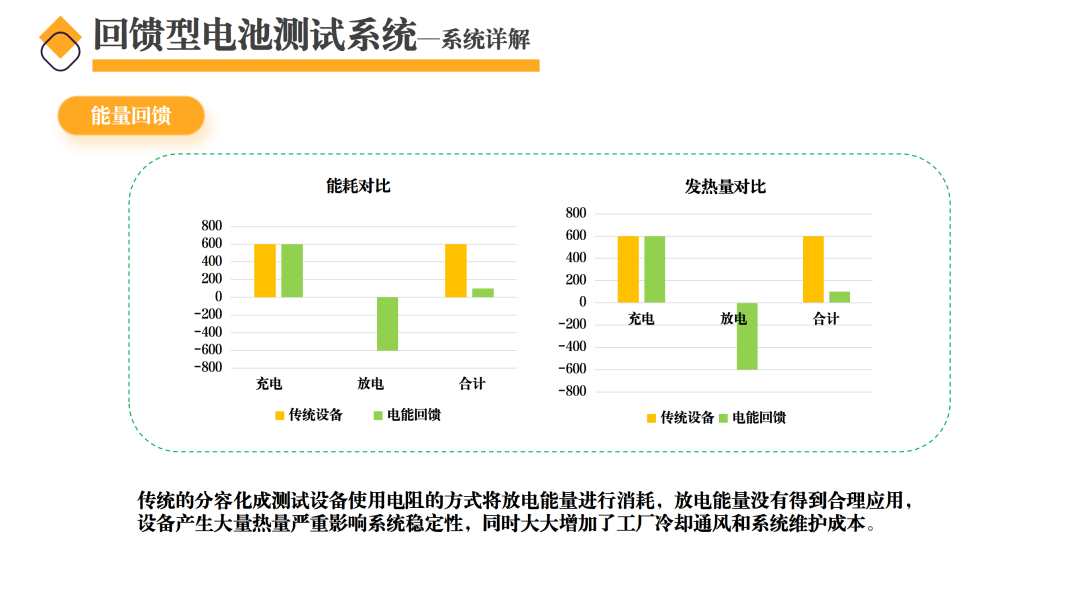
Resistive load: Only suitable for short-term testing of small samples in laboratories; all discharge energy is converted into heat, resulting in extremely high electricity costs for mass production, making long-term use unworthwhile;
Energy Feedback Type: Discharged electricity is fed back into the plant grid, with a feedback efficiency of 90%~96%. The production line saves electricity costs over 2-3 years and covers equipment purchase price differences, enabling stable full-load operation for 7×24 hours continuous.
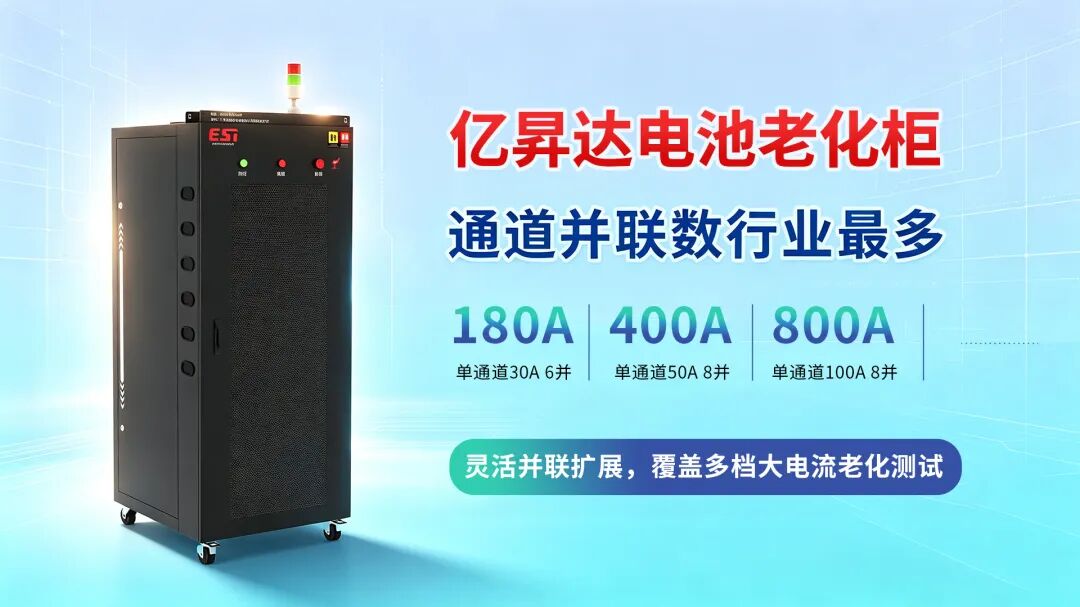
High current testing supports channel parallel connection
If you need ultra-high current test modules above 200A, prioritize models supporting 2~4 channel parallel outputs, eliminating the need to customize single-channel 100kW ultra-high power equipment, significantly reducing procurement costs.
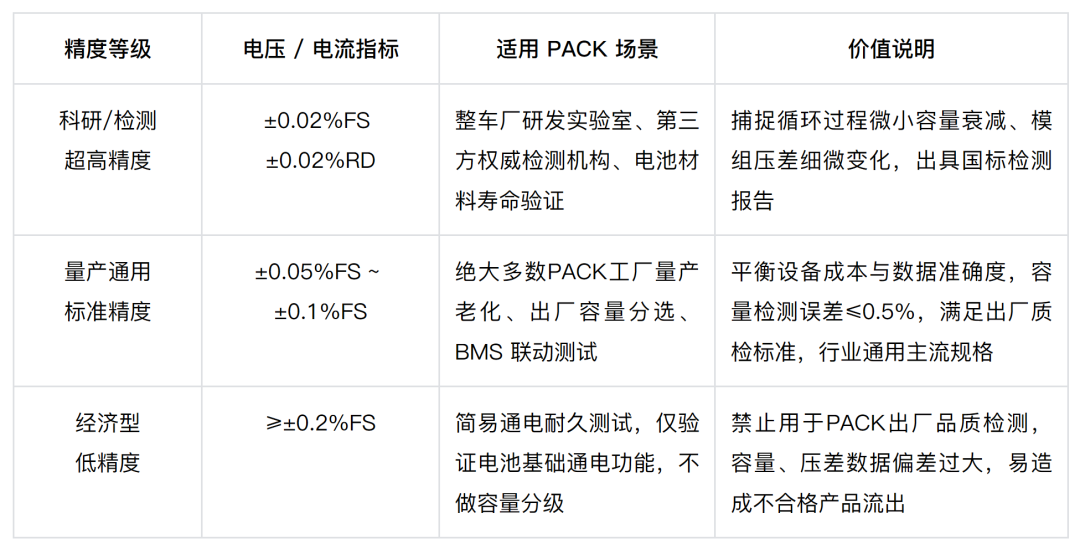
Industry standardization standard: ± X% FS (full-scale error) ± Y% RD (reading error). PACK does not require cell-level extreme precision and is graded according to usage scenario to avoid budget waste.
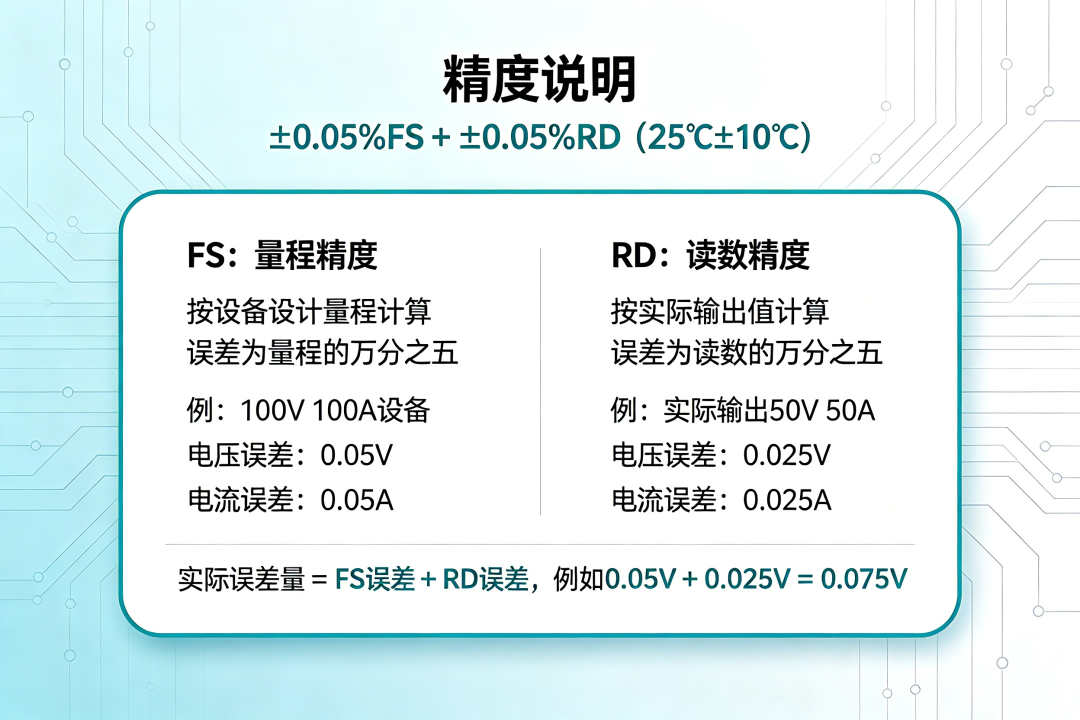
Devices with only single errors are rejected
Low-cost equipment is only marked with ±0.1% FS, with no RD reading error; Under low current PACK conditions, reading errors are amplified, and capacity detection is severely distorted, so it is necessary to confirm both FS+RD error indicators simultaneously.
Resolution matches accuracy requirements
Low-voltage two-wheel PACK: current resolution ≥0.1A; high-voltage energy storage PACK above 400V: current resolution ≥0.5A; even higher precision cannot accurately collect real-time data from the battery pack.
Focus on verifying full-load temperature drift indicators
PACK aging cabinets often operate under full load for hundreds of hours straight, causing significant temperature and humidity fluctuations in the workshop; Qualified equipment has a full-load temperature drift ≤ 0.05% for 720 hours; after thousands of cycles for equipment exceeding the temperature fluctuation standard, the data continues to deviate.
The differential pressure acquisition accuracy cannot be overlooked
The core detection indicator of PACK is the single-cell voltage difference. The device performs single-channel independent multi-channel voltage sampling, with a single-cell sampling accuracy of ≤±1mV. Low-precision equipment cannot identify battery pack consistency defects.
Step 1:
Clearly define the test PACK category, lock the voltage range. For two-wheel/small energy storage modules, select models within 100V; New energy vehicles and large energy storage clusters directly use 400~1000V high-voltage models.
Step 2:
Calculate single-channel rated current and power based on battery capacity and test rate, with a 10% current reserve.
Step 3:
Considering daily aging capacity and single cycle duration, calculate the basic channel number, add 20% redundancy, and determine the final channel specification.
Step 4:
Matching Accuracy Grade: Mass production line selection ±0.05% FS standard accuracy; The R&D testing laboratory selects ±0.02% FS ultra-high precision; Simple durability testing uses economical equipment.
Step 5:
Match PACK-exclusive add-ons
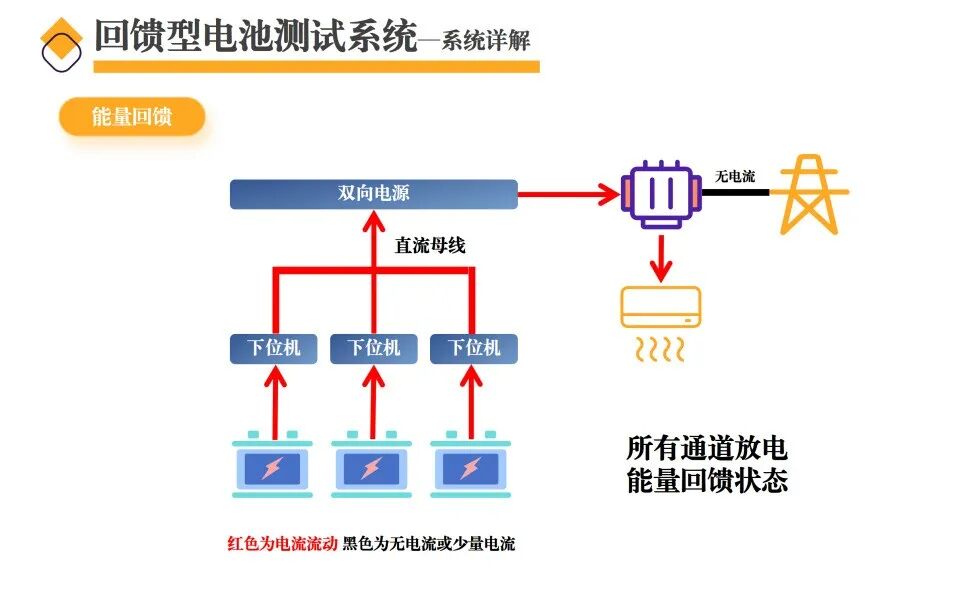
Energy feedback architecture is a must-have for mass production lines;
Battery pack test with BMS: standard CAN2.0/RS485 communication protocols;
Production line automation integration: select models with host computer data interfaces and support MES system integration;
High-temperature aging support: Can be linked with a temperature-controlled room, and the equipment features temperature control signal interaction functions.
Product: 48V 20Ah electric vehicle lithium battery, 1C standard cycle aging. Requirement: Output 300 battery packs per day
Voltage and power selection: 100V 30A single channel, single channel power 3000W, energy feedback type;
Channel calculation: single cycle 8 hours, single channel cycling 3 times per day, basic 100 channels, redundant with 3 40-channel cabinets;
Precision configuration: ± 0.05% FS standard mass production accuracy, supports real-time BMS differential pressure data acquisition.
Product: 72V 30Ah electric motorcycle battery module, 0.5C cycle, multi-specification sample mixing
Voltage and power: 150V20A single channel;
Channel specifications: 12-channel independent circuit, capable of testing multiple modules with different capacities simultaneously;
Precision configuration: ± 0.05% FS ultra-high precision, supports dynamic operating simulation and pulse charge/discharge testing.
Product: 800V 150Ah complete vehicle PACK, 0.2C long cycle life validation
Voltage and power: 1000V 50A single channel, single channel 50kW high-power feedback;
Channel specifications: single high-voltage model with 2 channels and independent high-voltage insulated circuits;
Precision configuration: ± 0.02% FS high precision.
Only focus on the number of channels, ignoring the voltage and current limits of each channel:
No matter how many channels there are, if the rated parameters are insufficient, full rate aging cannot be achieved, and the equipment completely fails to meet the production line requirements;
Blindly selecting ultra-high-precision models for mass production lines:
± 0.05% precision is sufficient for factory quality inspection, while 0.02% precision equipment comes with a high premium, significantly increasing procurement costs and causing budget waste.
For mass production lines, non-feedback resistive load aging cabinets are selected:
Long-term continuous cycles cause huge electricity cost losses, with the price difference far exceeding the equipment price difference within two years;
Shared power module models for procurement channels:
PACK battery BMS signals are sensitive, causing multiple packs to interfere with each other during synchronous testing, resulting in invalid capacity and differential pressure test data;
Ignoring long-term full-load temperature drift and single-cell differential pressure sampling accuracy:
Short-term test data is normal, but after thousands of cycles, the error continues to shift, making it impossible to accurately screen battery packs that fail consistency;
Guangdong Yishengda | One-stop battery testing solution provider, specializing in the research and manufacturing of charge/discharge aging capacity separation equipmentIt has established a closed-loop system covering five major equipment systems, covering cell capacity distribution, module aging, comprehensive performance R&D and testing, final EOL inspection of PACK shipments, and post-stage balanced maintenance, enabling precise monitoring of battery lifecycle performance. Relying on independent hardware and software R&D capabilities and multiple equipment patents, the company's full range of equipment supports flexible non-standard customization for voltage, current, and channels. Equipped with a high-efficiency energy feedback solution, it effectively reduces enterprise production energy costs, and is equipped with multiple safety protections for the entire machine, strictly complying with lithium battery production safety standards.